 Image 1 of 1
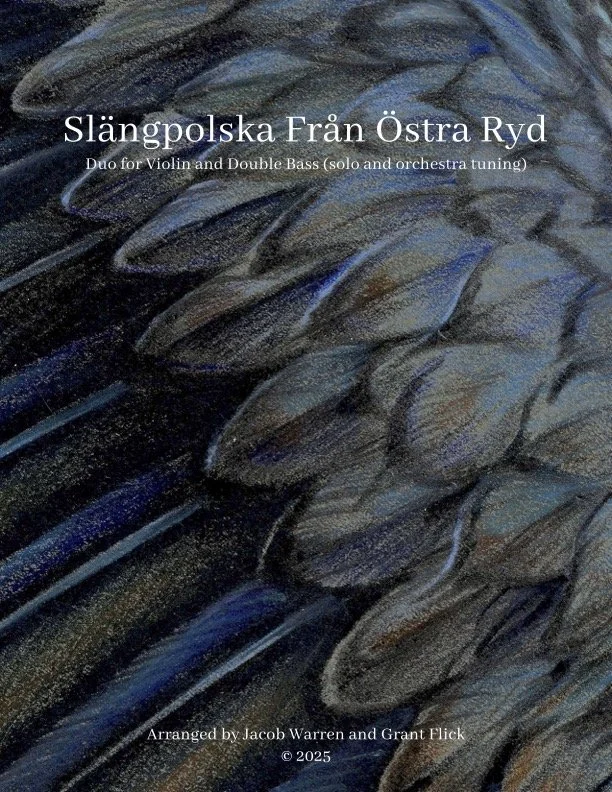
Thanks so much for checking out our arrangement of “Slängpolska Från Östra Ryd.” This score is a transcription of our Cormorant version, which you can find here. We first heard this tune on I Walked Abroad by Laurel Premo and Anna Gustavsson.
This traditional Swedish tune comes from the rich polska tradition in Scandinavian dance fiddling. From what we’ve learned, the slängpolska features evenly emphasized beats, which makes it unique among the many types of polskas. Our rendition isn’t meant to be strictly traditional, but we aim to respect the tradition from which the tune comes. For another version closer to the tradition, we recommend checking out this video by Amy Hakanson if you are looking for another version of this tune that is more of the tradition. We also encourage anyone who enjoys this music to explore Swedish fiddling more broadly—a great place to start is the American Nyckelharpa Association.
Regarding the accompanimental passages of sixteenth notes with accents passed between the violin and bass: we notate the double stops only where there’s a groove-based accent. In practice, we hold the double-stop shape in the left hand until the next chord change, and while “shuffling” in groove, we may occasionally activate both notes—which works just fine!
For double bassists specifically: Jacob plays this arrangement in D major on a solo-tuned bass using “C major” fingerings. However, the part will work equally well (perhaps even slightly better) being played in standard tuning. We’ve included scores and parts for both solo and orchestral tunings to give you the most choice!
Finally, please view this score as a suggestion rather than something absolute. While most of the arrangement is written out, we often improvise, especially in the accompaniment. Think of the written parts as a foundation, and feel free to vary them as you like.
Thanks so much for checking out our arrangement of “Slängpolska Från Östra Ryd.” This score is a transcription of our Cormorant version, which you can find here. We first heard this tune on I Walked Abroad by Laurel Premo and Anna Gustavsson.
This traditional Swedish tune comes from the rich polska tradition in Scandinavian dance fiddling. From what we’ve learned, the slängpolska features evenly emphasized beats, which makes it unique among the many types of polskas. Our rendition isn’t meant to be strictly traditional, but we aim to respect the tradition from which the tune comes. For another version closer to the tradition, we recommend checking out this video by Amy Hakanson if you are looking for another version of this tune that is more of the tradition. We also encourage anyone who enjoys this music to explore Swedish fiddling more broadly—a great place to start is the American Nyckelharpa Association.
Regarding the accompanimental passages of sixteenth notes with accents passed between the violin and bass: we notate the double stops only where there’s a groove-based accent. In practice, we hold the double-stop shape in the left hand until the next chord change, and while “shuffling” in groove, we may occasionally activate both notes—which works just fine!
For double bassists specifically: Jacob plays this arrangement in D major on a solo-tuned bass using “C major” fingerings. However, the part will work equally well (perhaps even slightly better) being played in standard tuning. We’ve included scores and parts for both solo and orchestral tunings to give you the most choice!
Finally, please view this score as a suggestion rather than something absolute. While most of the arrangement is written out, we often improvise, especially in the accompaniment. Think of the written parts as a foundation, and feel free to vary them as you like.